Things to Do on Symi: from the Kali Strata to Panormitis and the Boat-Only Beaches
The essential things to do on Symi are few and close together: walk the harbour at Gialos, climb the Kali Strata to the old upper town of Horio, and look out from the castle at the top. With more time, take a taxi-boat to a beach that no road reaches, spend half a day at the monastery of Panormitis, walk one of the old paths across the island, and stay for the evening, when the day boats have gone and the harbour empties. Symi rewards slowness more than a checklist, so pick three or four priorities, not ten.
This guide lists the best things to do on the island, grouped by what they involve, with practical notes on time, cost and timing, and suggestions for a day trip, a weekend and a week.
The highlights at a glance
| Activity | Time needed | Best for |
|---|---|---|
| Gialos harbour walk | 1 hour | Everyone, first impressions |
| Kali Strata and Horio | 2–3 hours | Views, old-town lanes |
| The castle and Panagia tou Kastrou | 1 hour from Horio | The best view on Symi |
| Archaeological Museum | 1 hour | History and island life |
| Panormitis Monastery | Half a day | Pilgrimage, architecture, a quiet cove |
| Taxi-boat to St George’s Bay | Most of a day | The island’s most dramatic beach |
| Nos or Nimborio swim | 2 hours | Day-trippers, a quick swim |
| A waymarked walk | 1–4 hours | Walkers, spring and autumn |
| An evening on the harbour | An evening | Overnight visitors |
In and around Gialos
Walk the harbour
Gialos is the first sight of Symi and the place every visit starts. The harbour is lined with neoclassical mansions in ochre, salmon, red, light blue and white, built in the 19th century when Symi was at its most prosperous. A flat walk around the water takes around 20 minutes from the bus station on one side to Nos beach on the other, and about 10–15 minutes from the ferry port to the clock tower.
Along the way, the municipality’s own tourism site points out the cathedral of Timios Prodromos, the Customs house, the Fish Market, the stone bridge, the statue of the little fisherman, the 1881 clock and the old shipyard in the Harani district.
See the clock tower and the little fisherman
The clock tower has stood at the entrance to the harbour since 1881, a gift of the Petridis family, and it is the first thing arriving ferries see. Nearby is the statue of “Michalakis”, the little fisherman, by the Symian sculptor Costas Valsamis: a boy holding a fishing rod, a nod to the island’s many fishermen, young and old.
Visit the Town Hall square and the cathedral
The Town Hall, its square and the church of Agios Ioannis add an architectural and civic side to the harbour without leaving the town core. The cathedral of Timios Prodromos, near the waterfront, was built in 1830 and renovated in 1869.
Buy a natural sea sponge
Symi grew rich on sponges and at one point had the largest sponge-fishing fleet in the world. Its divers worked the Barbary coast of North Africa, especially around Benghazi, and the trade ran through Syros, London and the USA. The most distinctive souvenir you can take home is a natural sea sponge, sold in shops around the harbour.
Up the hill: the Kali Strata and Horio
Climb the Kali Strata
The Kali Strata, the “Good Way”, is a stairway of about 500 wide stone steps from Gialos up to Horio. Merchants and sponge captains built their houses along it, and between the mansions the sea appears again and again. It takes around 20–30 minutes, longer with photo stops. The route has little shade, so climb in the early morning or evening; the steps are lit after dark. If the climb is too much, the minibus runs up to Horio in about 10 minutes for €2.50.
Get lost in Horio’s lanes
Horio, or Ano Symi, spreads over the ridge above the harbour: narrow cobbled streets, with or without steps, decorated with colours and stones in many shapes, pebble-mosaic courtyards, and mansions, some restored and some still in ruins. Symi’s settlement has been protected since 1971 as a “historic place in need of special protection”, which is why it looks the way it does.
Climb to the castle
At the top of Horio are the remains of the Knights’ castle, built in the 14th century on the ruins of a Byzantine castle, and the chapel of the Virgin of the Castle at its highest point. Little remains of the fortress after an explosion in 1944, but the view over Horio and Gialos alone is worth the climb. The Symi town guide covers the route through the lanes.
Visit the museums
The Archaeological Museum of Symi, in the Agios Athanasios quarter of the village, spreads over three levels, including two 18th- and 19th-century mansions, with objects from prehistory to the 19th century. The renovated Historical Museum reopened in late 2020. Opening hours can change in hot weather, so check before you climb.
See the windmills and Pontikokastro
On the ridge at Mylos, east of Horio, stand the remains of the windmills that once ground the island’s grain; some are now homes. Nearby is Pontikokastro, the “mouse castle”, a prehistoric mound. It is also the start of a fine walk down to Agia Marina and Pedi.
Walk down the Kataraktis
Horio has a second, lesser-known stair-path, the Kataraktis (“waterfall”), which descends around the western side of the acropolis into the back of Gialos. Its steps are longer, so there are fewer of them; allow 15–25 minutes. Up the Kali Strata, down the Kataraktis: the perfect circuit.
Panormitis and the monasteries
Spend half a day at Panormitis
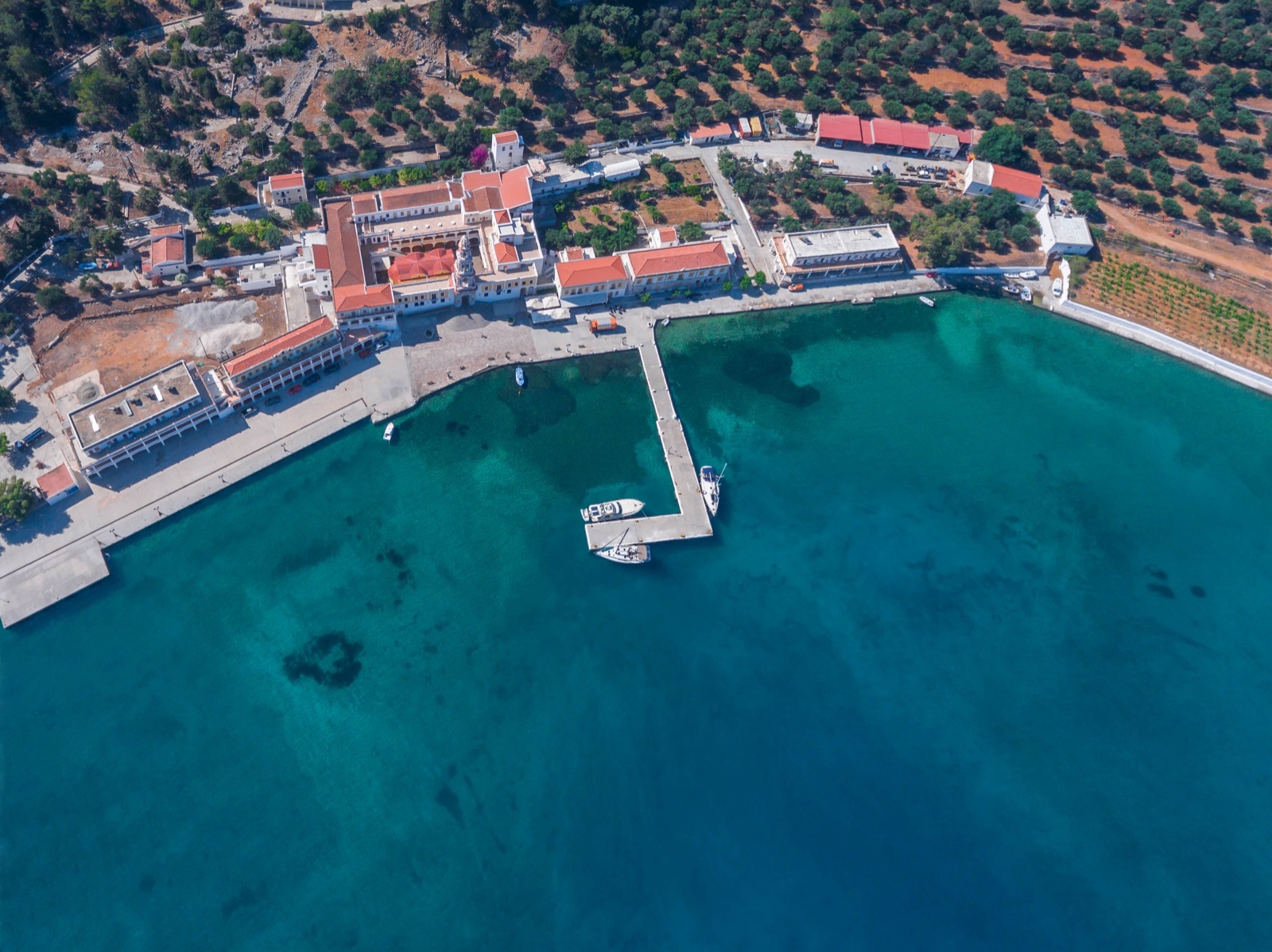
The monastery of the Archangel Michael at Panormitis, in a sheltered bay in the south-west, is the island’s most important pilgrimage site and the second largest monastery in the Dodecanese. Its multi-storey Baroque bell tower welcomes boats into the bay; the courtyard has a black-and-white pebble mosaic; the church holds a full-length icon of the Archangel covered in silver and gold. There is an ecclesiastical museum, a folklore museum, a library and a bakery, and a small sandy beach beside the monastery.
Allow at least half a day, and dress respectfully, with shoulders and knees covered. Get there by a ferry or day boat that calls at the monastery, or by road: the Panormitis bus takes around 40 minutes and costs €10 return. Many day trips from Rhodes stop at Panormitis on the way to Symi town. The Panormitis guide covers it in depth.
Go for Panormitis Day
On 8 November the monastery celebrates its annual feast, attracting pilgrims from across Greece, and the season ends with it. If you want to see the island at its most devout, this is the day; book a long way ahead.
Find the smaller monasteries
Symi has many chapels and monasteries scattered across its hills. The monastery of Archangel Michael Roukouniotis, built by the Knights of St John in the 15th century, is by tradition the oldest on the island. On the walks over the central ridge you pass Panagia Strateri, Agios Prokopios and many more. Some are kept locked; treat an open door as a bonus.
Beaches and the sea
Take a taxi-boat to St George’s Bay
Agios Georgios Dysalona is the island’s most dramatic beach: a small pebble cove beneath a sheer cliff about 300 m high, with a chapel on the edge of the rock and no road at all. The main ferry operator’s advice is that if you take only one boat excursion on Symi, make it this one. Taxi-boats leave the centre of Gialos harbour from late morning; return fares on the east coast run cost €10–€17. There are no facilities, so take food, water and shade, though the cliffs shade the beach after noon.
Swim at Agios Nikolaos or Agia Marina
For families, the calm, shallow, sandy beaches near Pedi are the easy choice. Agios Nikolaos has a taverna, sunbeds and tamarisk shade; Agia Marina has a tiny islet with a chapel just offshore. Both are a short boat ride or walk from Pedi; the Pedi guide covers them.
Have a quick swim near town
On a day trip, the swims within walking distance are Nos and Nimborio. Nos, about 15 minutes’ walk from the port past the clock tower, is a man-made beach of sand and gravel some 75 m long, with loungers and a taverna; the water drops off quickly, and water shoes help. Nimborio, west of Gialos, has a large pebble beach, and just inland the “Twelve Caves”, twelve Byzantine domes once used as painting and sculpture workshops.
Circle the island by boat
Full-day boat trips around Symi vary from day to day but usually include Seal Cove, St Nicholas beach and a barbecue lunch. They reach the west and south coasts, including remote Maroni beach, which is reached only by boat, and the islet of Sesklia to the south.
Walks, food and evenings
Walk one of the old paths
Symi has a network of old paths and waymarked trails. The easiest is the 1 km coastal path from Pedi to Agios Nikolaos, about 20 minutes. The finest half-day is the 4.6 km walk from the windmills above Horio via Pontikokastro down to Agia Marina and Pedi, about 1 hour 45 minutes. On the central ridge, a path leads to restored Byzantine wine presses; about 130 have been found on the island. Walk in spring or autumn, start early, and carry plenty of water. The hiking guide has every route.
Eat Symi shrimp and the island’s dishes
Symi is not only visual but culinary. Leave room for the local seafood, above all Symi shrimp, tiny and fried crisp. Other specialities include atherinopita, akoumia, prickly pear liqueur and traditional Symi cheese pies, all best enjoyed slowly at a harbour table. Small tavernas do not always accept cards, so carry cash.
Stay for the evening
The single best thing to do on Symi may be to stay. Around six in the evening the day boats leave Gialos and take several hundred visitors with them, and the harbour empties. The shopkeepers sit outside, the mansions glow, and dinner on the quay feels like a different island. Look out too for events at the island’s congress centre in the old Opera House. The where to stay guide explains the options.
If you only have a day
On a typical day trip from Rhodes you have around six hours on Symi, depending on the sailing and the season; other trips give 3–5 hours of free time. The first thing to do when you step ashore is to check the departure time of your return boat and save it on your phone. Then keep it simple:
- First hour: walk the Gialos waterfront, coffee, first photographs.
- Second and third hours: climb the Kali Strata and explore Horio while the sun is not yet at its strongest.
- Fourth hour: lunch by the water.
- Fifth hour: a swim at Nos or Nimborio, close by with no long transfer.
- Last hour: the lanes, a little shopping, coffee on the harbour.
- 30 minutes before departure: be at the harbour. The boat will not wait.
What not to try on a day trip: Panormitis and the boat-only beaches. They do not fit comfortably into a few hours unless your boat stops there, as some do. Day trips that include Panormitis or St George’s Bay are on the tours page, and the getting to Symi guide explains the regular ferries.
If you have a weekend
Two nights covers the highlights plus one beach boat trip or Panormitis:
- Day one: Gialos, the Kali Strata, Horio and the castle, and the evening on the harbour.
- Day two: a taxi-boat to St George’s Bay or Nanou, or the bus to Panormitis.
- Morning three: the Kataraktis or the Pedi coastal path before your boat.
If you have a week
Three to four nights is the island’s sweet spot, and a week lets you revisit favourite beaches and find the hidden corners. Add the walks over the central ridge, a round-the-island boat trip, Pedi and its beaches, Nimborio and the Twelve Caves, and a slow day at Panormitis, ideally staying the night when the day boats have gone.
On a hot afternoon
In July and August the hours from midday to late afternoon are the time to stop, not to climb. Do as the island does: a long lunch in the shade, a swim, a siesta. If you are on a beach reached by boat, the cliffs at St George’s Bay give shade after noon. In town, the museums are cool inside, though hours can change in hot weather; on one July day in 2025 the Archaeological Museum closed from 12:00 to 15:30 because of the heat. Save the Kali Strata and the castle for the evening, when the steps are lit and the light on the harbour is at its best.
When to go
May, June, September and early October offer warm sea temperatures and pleasant weather on Symi. July and August are hotter and much busier, and in summer the island can receive 1,000 to 5,000 visitors a day. Symi is built vertically, so heat matters: walking around in August can feel like an endurance challenge. The season runs from Easter to Panormitis Day in early November; outside it, many tavernas close and the taxi-boats stop. The Symi weather page has the forecast and monthly averages.
Practical tips
- Wear comfortable shoes. Steps and cobbled lanes are not kind to flip-flops.
- Carry water, a hat and sunscreen, above all on the Kali Strata.
- Bring cash for the bus, the taxi-boats and small shops.
- Bring a valid ID card or passport on the boat from Rhodes; it is required for all passengers.
- Respect the monasteries: cover shoulders and knees.
- Check the boats and the wind. Port authorities can stop sailings in bad weather.
Frequently asked questions
What is Symi best known for?
Its harbour of colourful neoclassical mansions, the Kali Strata stairway to Horio, the monastery of Panormitis, and boat-only beaches such as St George’s Bay. Symi once had the largest sponge-fishing fleet in the world.
What can you do on Symi in one day?
Walk the Gialos harbour, climb the Kali Strata to Horio, eat by the water and swim at Nos or Nimborio. Panormitis and the boat-only beaches need more time, unless your boat stops there.
How many days do you need on Symi?
Three to four nights lets you see the whole island at a comfortable pace. Two nights covers the highlights plus one beach trip or Panormitis.
Is Symi worth visiting?
Yes, even for a short visit. The harbour alone makes a powerful first impression, and staying overnight adds the empty evening harbour, the remote beaches and the walks.
What should you eat on Symi?
Symi shrimp, tiny and fried crisp, plus atherinopita, akoumia, prickly pear liqueur and Symi cheese pies.