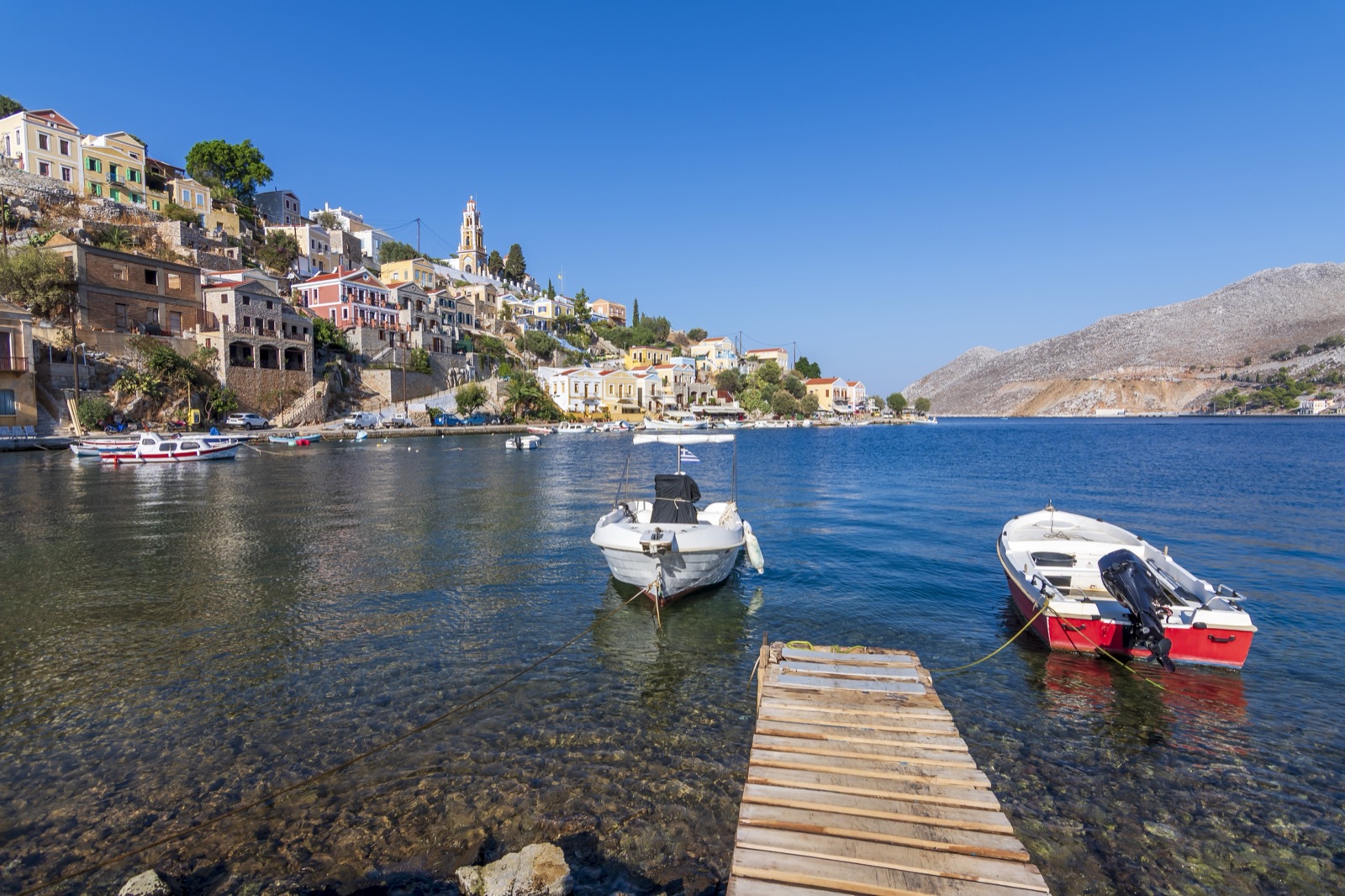
Getting Around Symi: the Bus, Taxis, Taxi-Boats, Scooters and Walking
Getting around Symi is simple once you know that the island has one short road network and a coastline full of bays that no road reaches. A small minibus runs between the harbour at Gialos, the upper town of Horio and the bay at Pedi, hourly through the day, for a flat €2.50 one way. A second bus goes to Panormitis Monastery a few times a day. Taxis wait near the bus terminal, cars and scooters can be hired at the harbour, and from May to mid-October taxi-boats carry swimmers to the beaches. For the town itself, your feet and the Kali Strata do the rest.
This guide explains each option in turn: what it costs, how often it runs, where it leaves from, and which one suits which trip.
Symi transport at a glance
| Option | Where it goes | Cost | Good for |
|---|---|---|---|
| Minibus | Gialos – Horio – Pedi | €2.50 one way, cash | Avoiding the steps, Pedi beach |
| Panormitis bus | Gialos – Panormitis Monastery | €10 return, on board | The monastery without a car |
| Taxi | Anywhere on the road network | Agree the price first | Luggage, evenings, Horio |
| Taxi-boat from Gialos | East coast beaches | €10–€17 return | Beaches with no road |
| Taxi-boat from Pedi | Agios Nikolaos, Agia Marina | €7/€8 return | Short beach hops |
| Hire car or scooter | Roads and tracks | Varies | Remote corners, Panormitis |
| On foot | Town, nearby beaches, trails | Free | Almost everything in town |
Fares and times in this guide come from the boards and reports published for recent seasons. They change, so treat them as a guide and check locally.
The shape of the island’s roads
Symi has no airport, so every visitor arrives by sea, almost always at Gialos, the harbour town. From there one road climbs past the windmills to Horio, the old upper town on the ridge, then drops into the valley to Pedi, a bay on the far side. Another road runs along the coast west to Nimborio. From the high ground above town, the longest road on the island crosses the bare interior and winds down through pine forest to Panormitis, in a sheltered bay in the south-west.
That is almost the whole network. Most of Symi’s coast is cliffs and coves with no road at all, which is why the boats matter as much as the bus.
The minibus: Gialos, Horio and Pedi
The island’s main bus is a small minibus rather than a coach. It leaves from a terminal on the south side of Gialos harbour, between the pier where the Sebeco ferries stop and Pantelis restaurant. The terminal is little more than a parking area at the side of the road, so it is easy to miss when the bus is not there.
The route climbs up past the windmills, with views down into the harbour, turns into Horio, and carries on down to Pedi, ending by the beach. It takes about 10 minutes to reach Horio and 20 minutes to reach Pedi.
When it runs
- Buses normally run hourly from 8am.
- They leave Gialos on the hour and return from Pedi at half past.
- There is no departure at 15:00 from Gialos and none at 15:30 from Pedi, the driver’s break.
- The last bus is earlier in low season; in high summer sources quote anywhere from about 22:00 to midnight, so check the board.
- In season that makes 28 departures a day.
Nobody publishes the timetable online. The current one is posted on a board at the Gialos terminal and changes with the season, so read it on your way past in the morning, especially if you plan to come back late from Pedi.
Fares and tips
A journey costs €2.50 one way, whether you ride to Horio or all the way to Pedi. You pay the driver in cash as you board; there is nothing to buy in advance. The minibus fills up, particularly on mid-morning and late-afternoon runs, so arrive early if you want a seat. Large suitcases are awkward, so for an arrival with heavy bags a taxi is the better choice.
For day-trippers, the bus is the easy answer to the Kali Strata. Ride up to Horio in the cool of the morning, explore, and walk back down the steps to the harbour. Just remember the 15:00 gap, which falls close to when many day boats leave.
The Panormitis bus
A second route runs from Gialos to the monastery of Panormitis in the far south. It is a different bus, turquoise rather than the yellow of the Horio–Pedi minibus, and it runs much less often: three services in each direction a day in high season and two in low season. There is usually one early in the morning, one mid-morning and one early in the afternoon, with slight changes at weekends.
The journey takes around 40 minutes on a winding mountain road with hairpin bends; if you suffer from travel sickness, prepare for it. Tickets cost €10 return and are bought on board. Check the times at the terminal board the day before, and plan your return carefully, because missing the last bus back means a taxi.
Panormitis deserves time. Allow at least half a day if you want to see the church, both museums and the cove, and dress for an active monastery, with shoulders and knees covered. The Panormitis guide explains what you will find there.
Taxis
Symi has a small number of taxis, and the rank is on the harbour front close to the bus terminal. Supply is limited, so book ahead, especially in the evening, when everyone wants a ride back from dinner in Horio or Pedi. Taxis often do not use meters, so agree the price before you set off.
Taxis earn their keep in a few situations:
- Arriving with luggage, especially if you are staying in Horio, where the car stops at the edge of the lanes and you walk the last stretch.
- Late evenings, after the last bus.
- Panormitis, when the bus times do not suit.
- The head of a track to a beach or a walk.
Ask your accommodation for a driver’s number when you arrive; it is the easiest way to get a car in the evening.
Taxi-boats to the beaches
Many of Symi’s best beaches have no road. Four of them, Agios Georgios Dysalona, Agios Vasilios, Maroni and Nanou, are reached only by sea or on foot. The taxi-boats close that gap, and for most visitors they are the most memorable way of getting around the island.
From Gialos
Taxi-boats leave from the centre of Gialos harbour, where boards on the quay list the beaches and times. They run a regular schedule along the east coast, calling at Agia Marina, St Nicholas (Agios Nikolaos), St George’s Bay, Nanou and Marathounta.
- Boats normally leave hourly until lunchtime: 10am, 11am, 12pm and 1pm.
- They return hourly in the afternoon: 2pm, 4pm, 5pm and 6pm.
- As with the bus, there is no service at 3pm.
- Return fares cost €10–€17, depending on how far you go.
Pick your return time when you buy your ticket and be on the beach in good time; the skipper collects at the time agreed. A fast boat to Nanou takes about 20–30 minutes depending on stops, and the ride to Agios Nikolaos about 20 minutes.
From Pedi
A small taxi-boat runs from Pedi harbour to Agios Nikolaos and Agia Marina. It has no fixed timetable from Pedi but leaves up to every 20 minutes when there are enough passengers; return times are hourly. The ride takes 5 minutes to Agios Nikolaos and 10 minutes to Agia Marina, and costs €7/€8 return. Caiques from Pedi stop running in the late afternoon.
Season
Taxi-boats and boat trips normally run only between May and mid-October. Outside that window, the boat-only beaches are effectively out of reach unless you hire a boat with a skipper. The meltemi, strongest from mid-June to early September and usually at its height in the afternoon, can also cancel or shorten sailings to the more exposed bays.
Round-the-island boat trips
Several boats run full-day trips around the island from Gialos. Itineraries vary from day to day but usually include Seal Cove, St Nicholas beach and a barbecue lunch. They are a good way to see the west and south coasts, which the taxi-boats do not cover.
Hiring a car or scooter
Cars, scooters, motorbikes and quad bikes can be hired in Gialos, a few metres from where the boats come in. A vehicle is useful for the remote parts of the island: Panormitis, the high monasteries, the tracks to Marathounta and Xisos, and trailheads.
Rental rules vary between firms, but these are typical of what local companies publish:
- Minimum rental: 1 day.
- Driver’s age: 21 to 75 at one firm.
- Licence: held for at least 2 years; drivers from outside the EU need an international driving licence.
- Scooters: EU drivers need a motorbike or moped licence valid at home; drivers from outside the EU need an international motorbike or moped licence. Helmets are compulsory and are provided free.
- Island only: rented vehicles may not be taken off Symi.
- Delivery: some firms deliver around the island, though one excludes Panormitis Monastery.
- Season: one scooter firm rents from 1 April until 15 November.
Do you need a vehicle?
Probably not for a short stay based in Gialos, Horio or Pedi. The bus links all three, the boats reach the beaches, and the town is a place for walking. For one day on Symi you certainly do not: Gialos, the Kali Strata, Horio and the nearby beaches can all be covered on foot. A vehicle becomes worthwhile if you stay a week, want to reach Panormitis on your own schedule, or plan hikes that start from the interior road.
If you hire, take it slowly. The roads are narrow and steep, with hairpins on the Panormitis road, goats on the tarmac, and very little parking in Gialos and Horio, where the lanes are for feet only. Park at the edge and walk in.
Bringing your own car
Most boats from Rhodes are passenger-only. If you want to bring a vehicle, check which ship serves your date before you book: the Dodekanisos Seaways ferry Panagia Skiadeni carries vehicles, while the catamarans handle most day-trip routes from May to October.
Walking around town
Walking is how Symi is meant to be seen. The harbour at Gialos is flat; it takes around 20 minutes to walk from the bus station on one side round to Nos beach on the other, past the clock tower, and about 10–15 minutes from the ferry port to the clock tower.
The Kali Strata, about 500 stone steps up to Horio, takes around 20–30 minutes. The route has little shade, so carry water and avoid the hottest part of the day; in the evening the steps are lit. Horio’s lanes are narrow, cobbled and often stepped, and they are for pedestrians only.
From Horio you can walk down the main road to Pedi in 10–15 minutes, or about 45 minutes from Gialos via Horio. Nimborio, west of Gialos, is 3 km along the coast road or 2.3 km by the inland route, which makes a good circular walk. For the island’s waymarked paths, see the hiking guide.
Getting around with luggage
Arrival day is the one time getting around Symi takes planning. If you are staying on the harbour, you can usually walk from the boat. For Horio, take a taxi or the bus to the top and walk from the road; Horio’s 500 steps are a real daily consideration with luggage, children or limited mobility, though there is road access to the edge of the village. For Pedi, the bus works if you travel light, and a taxi if you do not. Many owners will arrange a pick-up if you ask before you travel.
Getting around with children or limited mobility
The minibus and taxis cover the three main settlements, and the taxi-boats take children happily, though climbing in and out at a beach jetty can be awkward. Agios Nikolaos and Agia Marina are both considered safe for children, with calm, shallow water. The steps and cobbles of Horio are hard with a pushchair or a wheelchair; the waterfront at Gialos is the easiest part of town.
Getting around out of season
From late autumn to spring, Symi’s transport shrinks to its everyday core. The minibus keeps running on a reduced winter schedule, earlier in the evening, and the Panormitis bus drops to fewer services. The taxi-boats and round-the-island trips stop after mid-October, so the boat-only beaches are out of reach unless you arrange a private boat. Many rental firms close too; one scooter firm rents only from 1 April until 15 November. If you visit in winter, ask your host about taxis and timetables when you book, and expect to walk more. The regular ferries from Rhodes still run every day, all year.
Which option for which trip
- Gialos to Horio: walk up the Kali Strata in the morning, or take the minibus up and walk down.
- Gialos to Pedi: minibus, 20 minutes, €2.50.
- To Panormitis: the Panormitis bus, a taxi, or a ferry that calls at the monastery.
- To Agios Georgios Dysalona or Nanou: taxi-boat from Gialos.
- To Agios Nikolaos or Agia Marina: taxi-boat from Pedi, or walk.
- To Nos beach: walk round the harbour.
- To Nimborio: walk or drive the coast road.
- Late at night: a pre-booked taxi.
Getting there in the first place
All of this starts at Gialos harbour. Boats from Rhodes run every day, all year, with the shortest crossing taking 45 minutes; Symi also has ferry links with Kos, Kalymnos, Leros, Lipsi, Nisyros, Patmos, Tilos and Piraeus. The getting to Symi guide covers the routes, and day trips from Rhodes are on the tours page. For a forecast before a boat day, see the Symi weather page.
Frequently asked questions
Is there a bus on Symi?
Yes. A minibus runs from Gialos harbour up to Horio and down to Pedi, hourly from 8am, for €2.50 one way, paid in cash. A separate bus runs to Panormitis Monastery a few times a day.
How much is a taxi-boat on Symi?
Return fares from Gialos cost €10–€17 depending on the beach, and the short hop from Pedi to Agios Nikolaos or Agia Marina costs €7/€8 return.
Can you get to Panormitis by bus?
Yes. The Panormitis bus runs three times each way a day in high season and twice in low season, takes around 40 minutes and costs €10 return.
Do you need a car on Symi?
Not for a short stay. The bus, taxis, taxi-boats and walking cover Gialos, Horio, Pedi and the main beaches. A car or scooter helps for Panormitis, remote monasteries and trailheads.
When do the taxi-boats run?
Normally from May to mid-October, leaving Gialos hourly until 1pm and returning hourly from 2pm, with no boat at 3pm.