Practical
Rhodes Day Trip: Symi, Lindos or the Old Town? How to Choose
Most people staying on Rhodes end up weighing the same three days out: a boat to the island of Symi, a trip down the east coast to Lindos, or a day in Rhodes Old Town. Choose Symi for a day on the water and a harbour town that feels nothing like Rhodes; choose Lindos for the island’s great ancient acropolis above a white village and St Paul’s Bay; choose the Old Town when you want medieval history with no travel at all. With a week, you can do all three, and the best order is set less by taste than by the summer wind.
The practical differences are easy to compare. The fastest boats reach Symi in 45 minutes, most crossings take 1 to 1.5 hours, and organised day trips from Rhodes last about 6–9 hours. Lindos is about 1 hour from the city of Rhodes by car, and the acropolis ticket costs €20. The Old Town is on your doorstep: the Palace of the Grand Master is 10 minutes on foot from Mandraki, and its ticket is also €20.
This article compares the three on time, cost, heat, crowds and weather, then suggests how to fit them into a week. Prices and hours are those published for 2026; check before you go.
The short answer
- Choose Symi if you want a boat trip, a swim in a cove or a visit to the monastery at Panormitis, and a harbour of neoclassical mansions. It is a full day, and the sea sets the terms.
- Choose Lindos if you want ancient Greece: the sanctuary of Athena Lindia on its rock, the Knights’ walls around it and the bay below. Go early; it is a climb in the heat.
- Choose the Old Town for the medieval city of the Knights of St John, a UNESCO World Heritage Site, with the Palace of the Grand Master and the Street of the Knights. It is the easiest day, and the best one for evenings and windy weather.
- Do not try to combine Symi and Lindos in one day. The Symi boats take most of the day, and Lindos is about an hour away by road.
Side by side
| Symi | Lindos | Rhodes Old Town | |
|---|---|---|---|
| Getting there | Boat from Rhodes: fastest 45 minutes, most 1 to 1.5 hours | Bus from Mandraki, or about 1 hour by car | On foot from Mandraki |
| Time needed | A full day; organised trips run about 6–9 hours | Half a day to a day | A few hours to a day |
| Main costs | Ferry tickets from around €7; day-trip prices vary by operator | Bus €5.50 each way (posted fare); acropolis €20 full, €10 reduced | Palace €20 full, €10 reduced; walls €5 |
| Heat | About 500 steps up the Kali Strata, with little shade | A walk up to the acropolis, 10 minutes from the village | Streets, museums and the Palace interior |
| Weather risk | Sailings can be stopped by strong wind | Low | Low |
| Best for | Harbour, swim, monastery | Ancient site, St Paul’s Bay | Medieval city, evenings |
Symi: a day on the water
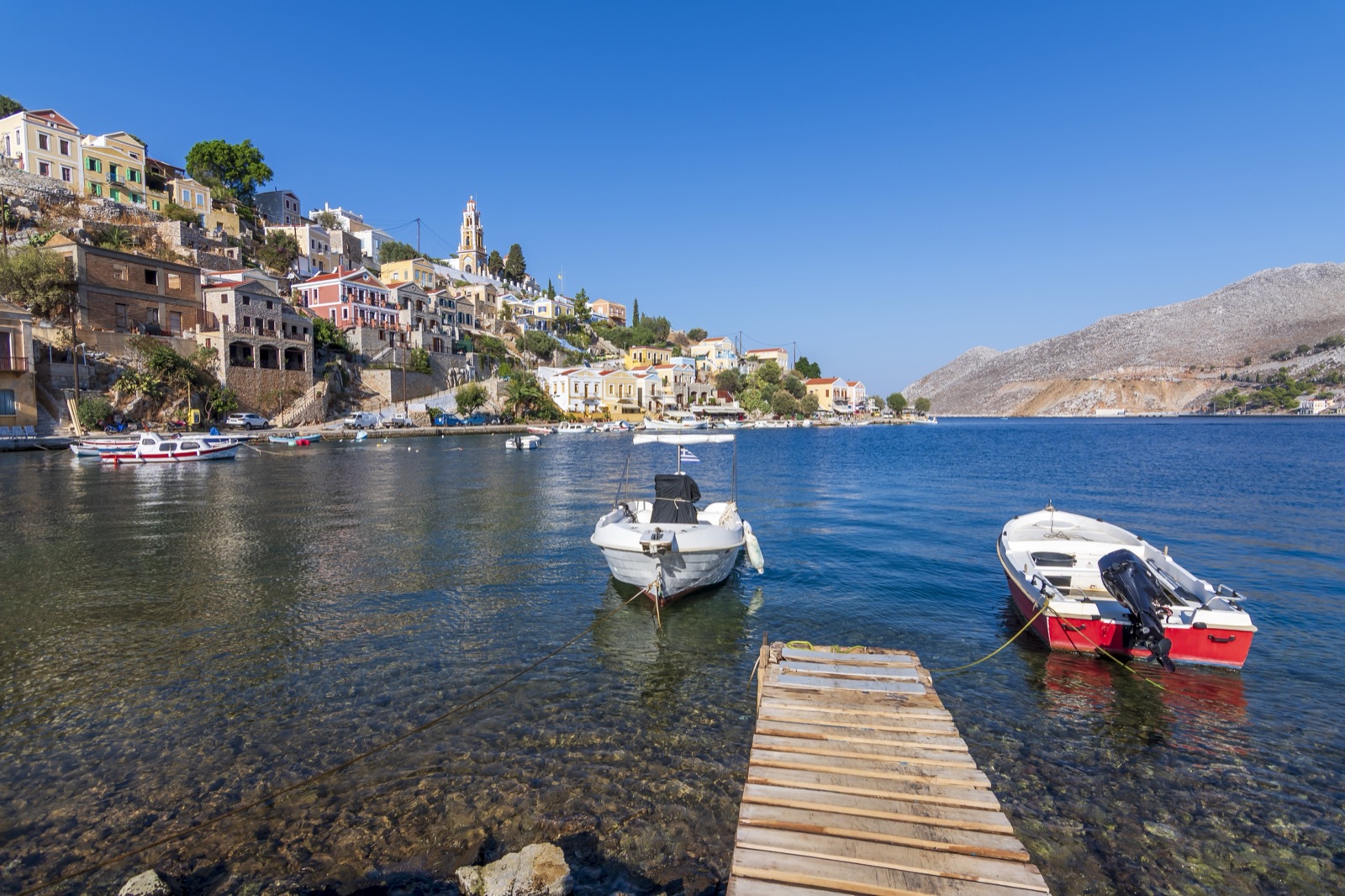
Symi lies about 24 km north of Rhodes, and the crossing is part of the day. Boats arrive at Gialos, the harbour town, where tiers of colourful neoclassical mansions climb the hillsides; Symi was at its most prosperous in the mid-nineteenth century, when many of them were built. From the quay, the Kali Strata, a stone stairway of about 500 steps, climbs to Horio, the upper town, and the castle at the top. Our Symi town guide covers what to see.
The ways to go
- Regular ferries. The shortest Rhodes–Symi crossing takes 45 minutes and boats run every day, all year; most crossings take about 1 to 1.5 hours, and tickets start from around €7. The route is served by Dodekanisos Seaways, Blue Star Ferries, Saos Ferries, Sea Dreams and Sebeco Lines.
- Organised day trips. Dodekanisos Seaways runs day trips from Rhodes from May to October, typically with 3–5 hours of free time on the island. Local excursion boats from Rhodes offer similar days.
- Day trips with Panormitis. A ferry day trip from Rhodes that stops at both the Monastery of Archangel Michael at Panormitis and Symi town takes about 9 hours and is on our tours page.
- Day trips with a swim. Some boats swap the monastery for a swim at St George’s Bay, a cove reached only by boat; see our article on St George’s Bay.
Our guide to getting to Symi compares the ferries and day trips in detail.
What to weigh up
- A fixed return. Whichever boat you take, the return time is not negotiable, so a Symi day is more structured than a day in Lindos or the Old Town.
- Crowds. Dodekanisos Seaways says Symi receives 1,000 to 5,000 visitors a day in summer, most of them arriving and leaving on the same boats. In July and August, it says, booking is essential because the boats fill up.
- The heat on the steps. The climb to Horio is hard work at midday in summer; the waterfront is the place to be in the hottest hours.
- The wind. Crossings can be delayed or cancelled in strong winds, which matters most in July and August (see below).
Lindos: the acropolis and St Paul’s Bay
Lindos is a village on Rhodes’ east coast crowned by one of the island’s most important archaeological sites. The acropolis is 10 minutes on foot from the village.
What you see
Lindos was one of the great cities of ancient Rhodes. It peaked in the Archaic period, when it became a major commercial and naval power under the tyrant Cleobulus, and its importance gradually declined after the city of Rhodes was founded in 407 BC. On the rock, the Doric temple of Athena Lindia and the Propylaea with their monumental staircase were built in the 4th century BC, and the Hellenistic Stoa is 87 metres long with 42 columns. The walls you see around the top are largely the work of the Knights Hospitaller, who strengthened the acropolis fortifications into their present shape.
Look out, near the base of the acropolis, for a relief of a trihemiolia, a Rhodian warship, carved into the rock and dated to 180 BC.
Opening hours and tickets
The hours published by Hellenic Heritage (hh.gr), which sells tickets for the site, change through the year:
- 1 April to 31 August: daily 08:00–20:00.
- 1 to 15 September: daily 08:00–19:30.
- 16 to 30 September: daily 08:00–19:00.
- 1 to 15 October: daily 08:00–18:30.
- 16 to 31 October: daily 08:00–18:00.
- 1 November to 31 March: 08:30–15:30, closed on Tuesdays.
Last admission is 20 minutes before closing. A full ticket costs €20 and a reduced ticket €10, and admission is free on 6 March, 18 April, 18 May, the last weekend of September and 28 October. Hours and prices can change, so check the Hellenic Heritage page for Lindos before you go.
Getting there
- By bus. KTEL Rodou buses to Lindos leave from Bus Station 1 at Mandraki, and the operator lists a one-way fare of €5.50 per person. At the time of writing, the timetable posted on its site was still the one marked valid from 1 June to 5 October 2025, so check the current departures before you plan around them.
- By car. About 1 hour from the city of Rhodes.
- On an organised tour. Tours to Lindos are sold across the island; they save the planning but fix your timings.
St Paul’s Bay
Below the acropolis lies St Paul’s Bay, with its small chapel. Tradition says that St Paul’s ship sought shelter here during a storm, and KTEL Rodou runs a separate Rhodes–Saint Paul bus service to the bay.
The history is less certain than the signs suggest. The Acts of the Apostles records that Paul stopped at Rhodes on his third journey, returning to Jerusalem (Acts 21:1). Writing for the Biblical Archaeology Society, Mark Wilson judges the Lindos tradition dubious: in his account of the voyage in Acts 20–21, Luke names specific harbours rather than just islands, and Wilson thinks Paul more likely landed in Rhodes town. He also notes that the culture ministry’s archaeological guide to Lindos makes no mention of such a visit. The bay is worth seeing either way; just treat the story as tradition.
Rhodes Old Town: history on your doorstep
If you are staying in or near Rhodes town, the Old Town needs no transport at all. The Medieval City of Rhodes was inscribed on UNESCO’s World Heritage List in 1988. The Knights of St John held Rhodes from 1309 and turned the city into a stronghold; it finally fell in 1522 after a six-month siege. The medieval city lies within a 4 km-long wall.
UNESCO describes the Upper Town, with the Palace of the Grand Masters, the Great Hospital and the Street of the Knights, as one of the finest urban ensembles of the Gothic period. The Great Hospital was built between 1440 and 1489 and now houses the archaeological museum.
The Palace of the Grand Master
Construction of the Palace began in the early 14th century, shortly after the Knights settled on Rhodes. It was partially destroyed by an explosion in 1856 and restored by the Italians in the early 20th century, so much of what you see inside is a reconstruction.
- Hours: from 1 April to 31 October, daily 08:00–20:00.
- Tickets: €20 full and €10 reduced.
- The walls: a separate ticket, €5 full, for the fortification walls, which open 12:00–15:00, Monday to Friday, from April to October, and are closed on Saturdays.
- Getting there: 10 minutes on foot from Mandraki.
- Access: the Palace lists a lift and accessibility among its amenities, which makes it the most accessible of the three days.
The Old Town is also the natural choice for the evening of your arrival, for a rest day between two busier ones, and for any day when the sea is too rough for Symi.
Heat, crowds and the time of day
All three are hot in high summer. HNMS’s long-term averages for Rhodes give afternoon highs of 30.4 °C in July and 30.7 °C in August, and there is almost no rain from June to August. Dodekanisos Seaways names May–June and September–October as the best months for day trips: warm, less crowded and less intensely hot.
How to handle the heat depends on the day:
- Lindos: be at the gate when it opens at 08:00 in summer, climb in the cooler morning, and spend the afternoon by the water at St Paul’s Bay or in the village.
- Symi: climb the Kali Strata as soon as you land, or leave it for the evening if you are staying; spend midday on the waterfront. The steps are lit after dark, and the cool hours of early morning and evening suit the climb.
- Old Town: walk the streets in the morning and evening, and spend the middle of the day inside the Palace and the museum.
Crowds follow the same clock. On Symi, the day boats leave Gialos around six in the evening and take several hundred visitors with them, so the harbour is at its quietest before they arrive and after they go. At Lindos and in the Old Town, arriving at opening time gives you the coolest hours and the best chance of a calmer visit. Rhodes is also a cruise port, so if crowds matter, check a published cruise schedule for your dates.
Let the wind decide the order
In summer the meltemi blows across the Dodecanese from the north-west, strongest from mid-June to early September. According to Meteopedia, the weather encyclopaedia of meteo.gr, it typically reaches 6 to 7 Beaufort and peaks around midday and in the afternoon. Port authorities can stop sailings in bad weather; Lindos and the Old Town are unaffected.
That gives a simple rule: book Symi early in your week and keep Lindos and the Old Town as flexible days. If your Symi boat is cancelled, you can move it to another day and do one of the land-based trips instead. If you travel on Dodekanisos Seaways and a departure is prohibited, you can change or refund the ticket; for an organised day trip, the operator will advise. Our article on Symi weather explains the wind and the seasons in more detail.
Doing all three in a week
A week on Rhodes is enough to see all three without rushing. One way to arrange it:
- Arrival evening: a first walk in the Old Town, along the walls and through the Street of the Knights.
- Early in the week: Symi. Pick a calm-looking day and leave a spare day after it in case the boat does not sail.
- Midweek: Lindos, with an early start to reach the acropolis at opening time, then lunch and a swim at St Paul’s Bay.
- Later in the week: the Old Town properly, with the Palace of the Grand Master, the walls on a weekday and the archaeological museum.
- Beach days in between. Three big days out in a week is plenty in July and August.
If you have more time, Symi is not the only island within reach. From Rhodes, Dodekanisos Seaways runs day trips to seven islands: Symi, Nisyros, Tilos, Halki, Kastellorizo, Kos and Kalymnos.
Costs at a glance
Figures as published for 2026 unless stated; all can change.
- Symi by ferry: tickets from around €7 each way.
- Symi by organised day trip: prices vary by operator, boat and inclusions; our tours page shows live prices.
- Lindos by bus: €5.50 each way, the fare posted with the 2025 summer timetable.
- Acropolis of Lindos: €20 full, €10 reduced; free on certain days.
- Palace of the Grand Master: €20 full, €10 reduced.
- Rhodes fortification walls: €5 full.
Which suits whom
- History lovers: Lindos and the Old Town, with Symi’s Archaeological Museum and castle as a bonus on a longer stay.
- Families: Symi is a hit for the boat ride, but the Kali Strata’s roughly 500 steps are a lot for small legs in the heat. Lindos and the Old Town are easier to cut short.
- Photographers: Symi’s harbour from the boat and from the steps; the acropolis and St Paul’s Bay at Lindos in the morning light.
- Limited mobility: the Old Town and the Palace of the Grand Master are the most accessible; Symi’s upper town and the Lindos acropolis both involve steep climbs.
Frequently asked questions
Is Symi or Lindos better for a day trip from Rhodes?
It depends on what you want. Symi is a boat trip to a different island, with a harbour town, swimming and the monastery at Panormitis; Lindos is Rhodes’ great ancient site, reached by road in about an hour. If you can, do both on different days.
Can you visit Symi and Lindos on the same day?
Not realistically. Organised Symi day trips take about 6–9 hours, and Lindos is about 1 hour from the city of Rhodes in the other direction. Give each its own day.
How do you get from Rhodes town to Lindos?
By KTEL Rodou bus from Bus Station 1 at Mandraki, with a posted one-way fare of €5.50, or by car in about 1 hour. The acropolis is 10 minutes on foot from the village.
How much does it cost to visit the Acropolis of Lindos?
A full ticket costs €20 and a reduced one €10, according to Hellenic Heritage’s page for the site. Admission is free on 6 March, 18 April, 18 May, the last weekend of September and 28 October.
Did St Paul really land at St Paul’s Bay?
That is the local tradition, and a chapel marks it. The Acts of the Apostles says only that Paul stopped at Rhodes, and at least one biblical archaeologist thinks he more likely landed in Rhodes town.
When is the best time for a day trip from Rhodes?
May, June, September and October, when it is warm but less crowded and less hot. In July and August, book boats ahead and start early; the afternoon wind is also strongest then.